Innsbruck 2026 Lead Finals: Ginés López and Pilz Light the Nordkette
By ZealZag Team
Innsbruck 2026 Lead Finals: Ginés López and Pilz Light the Nordkette
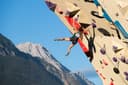
The Kletterzentrum's outdoor arena holds a specific kind of evening light in late June. By 7:30pm, the Nordkette ridge above the city is still catching the sun's last horizontal light at 2,334 metres while the arena itself — at 600 metres on the valley floor — has shifted into a softer, indirect blue. The lead wall, fifteen metres tall with a fifty-degree overhang carved into its upper section, becomes a sculptural object against this background. Athletes climbing it have a view that no indoor venue on the World Series circuit can replicate.
Tonight's lead finals delivered two winners who understood that view in different ways: Alberto Ginés López (Spain), arriving in Innsbruck as the Paris Olympic combined gold medallist with a 2026 season still building toward his next major target, and Jessica Pilz (Austria), who has been climbing competitively at this arena since she was a teenager and whose relationship with the Kletterzentrum's lead wall is the climbing equivalent of a striker's relationship with his home stadium.
Men's Lead Final: One Topout in Eight Attempts
The men's final route — set by Manuel Hassler and a team of three IFSC-level setters in the 36 hours preceding the final — was designed with an explicit purpose. The IFSC's chief route-setter described the brief in pre-event materials: "a route that asks every category of question — finger crimp, body tension, dynamic reach — without rewarding a single specialisation."
The route delivered the brief.
The men's final's first three sections were technical climbing on small holds at moderate angles, designed to consume forearm endurance without producing visible difficulty. The middle section transitioned into a steep overhang with widely spaced compression sequences. The final section — eight metres beneath the chains — was a series of dynamic moves on three-finger pockets, calibrated such that arriving at the section with adequate strength was the test, not the moves themselves.
Yannick Flohé (Germany) climbed first in the reverse-qualification order and set the early benchmark: he reached the second-to-last hold of the section before falling. Hold 39 of 41. A score that would, the climbers behind him understood, win the final unless someone topped the route.
Toby Roberts (Great Britain) — the boulderer whose lead form has improved across 2026 — reached hold 35.
Jakob Schubert (Austria) reached hold 38.
Sorato Anraku (Japan) reached hold 40 — one move short of the chains — and the crowd, recognising that Flohé's score was now under direct threat, generated a roar that visibly affected the route-setter's expression at the foot of the wall.
The remaining four climbers fell at lower points. Then Ginés López climbed.
The Spanish climber's approach to the route had been visibly different from the start of the final. Where most finalists had treated the technical lower section as endurance preservation, Ginés López had climbed it at a rhythm slightly above the pack's average — not faster, but more relentless, refusing the brief pauses on body-position adjustments that the other finalists had used. The energy expenditure was higher. The arrival at the dynamic upper section was earlier.
He topped the route.
Cleanly, on his fortieth move, with the chains clipped and both arms extended in a gesture more of confirmation than celebration. The Innsbruck crowd — knowledgeable in a way that competition crowds at less embedded venues rarely are — produced the response appropriate to the moment: extended, sustained, but with the specific texture of a crowd that has watched a thousand competition climbs and recognises the precise degree of difficulty of what they have just seen.
Ginés López wins.
Men's Lead Final Results: 1. Alberto Ginés López (Spain) — TOP 2. Sorato Anraku (Japan) — Hold 40 3. Yannick Flohé (Germany) — Hold 39 4. Jakob Schubert (Austria) — Hold 38 5. Toby Roberts (Great Britain) — Hold 35
Women's Lead Final: Pilz's Innsbruck
The women's final route — set later by the same team, calibrated for the women's field's specific competition profile — followed a structurally similar plan but with the dynamic upper section replaced by a long sequence of small-hold technical climbing on the steepest angle of the wall's upper bulge.
The route asked the question that the women's lead field had been waiting all season to be asked: who can hang the longest on small holds in a steep overhang?
Janja Garnbret (Slovenia) — the most decorated competition climber of her generation — could not climb tonight, sitting this final out as part of her measured 2026 build toward later season objectives. Her absence opened a final that, on form, was approximately five climbers' to win.
Jain Kim (South Korea) climbed beautifully through the route's lower technical section, reaching hold 33 of 38 before her fingers opened on a left-hand crimp. Thirty-seven years old, still operating at this level on this terrain. The Austrian crowd's appreciation was specific and warm.
Mia Krampl (Slovenia) reached hold 36.
Pilz climbed seventh.
Her approach to the lower section was visibly the most conservative of any finalist — she paused twice at body-position transitions that nobody else had treated as resting points, costing fifteen seconds of clock time but preserving an amount of forearm energy that the route's upper sections would prove to require. She arrived at the overhang's start with measurably more energy than the field average. The crowd, having watched her competition career in this arena since 2014, understood what was happening.
She reached hold 36. Then 37. Then the final move — a dynamic reach to the top hold — and clipped the chains.
TOP.
The Innsbruck crowd's response was the loudest sustained noise of the day. Pilz, walking down the climber's path from the wall's base to the lowering platform, kept one hand on her face throughout the descent.
Yufei Pan (China), climbing last, was the only remaining threat to Pilz's victory. She reached hold 36 — same as Pilz before her final move — and could not match the dynamic reach. Fall.
Pilz wins.
Women's Lead Final Results: 1. Jessica Pilz (Austria) — TOP 2. Yufei Pan (China) — Hold 36 3. Mia Krampl (Slovenia) — Hold 36 4. Jain Kim (South Korea) — Hold 33 5. Brooke Raboutou (USA) — Hold 32
Connect with training partners, earn travel miles, and discover terrain worth crossing borders for.
Join ZealZagFollow us on InstagramWhat This Innsbruck Week Established
The 2026 Innsbruck stop has established two things for the rest of the season. First, the men's lead competition has a fully restored Ginés López as a season-long contender, climbing with the precision that won him Olympic gold but with the conditioning to maintain it across a multi-round World Series weekend. Second, the women's lead competition is genuinely open. Garnbret will return to the circuit at the next round; her dominance, in the medium term, remains likely. But Pilz's performance tonight — on her home wall, against a strong field — confirms that the gap between Garnbret and the next-best lead climbers has narrowed throughout 2026.
The next World Series stop is Briançon, France, July 25-26. The boulder series continues at Chamonix in mid-July.
For climbers who want to experience the alpine terrain that defines Innsbruck's climbing culture, see our complete guide to climbing in Innsbruck: Nordkette, Karwendel, and Alpine Rock.
Meet a ZealZag Athlete
Keep reading
Mirosław's Last Race Is in Krakow — and the Whole World Is Watching
The World Climbing Series returns to Krakow's UNESCO Main Market Square with a new format and an unmissable storyline: Aleksandra Mirosław, Olympic champion and world record holder, racing in her home city in what she has said will be her final competitive season.
Speed Climbing Comes to a UNESCO Market Square: Krakow World Cup Preview
The World Climbing Series arrives in Krakow's UNESCO Heritage Market Square for a speed-only World Cup that debuts a radical new four-lane race format. Zhao Yicheng owns the 4.58-second world record; Sam Watson and Veddriq Leonardo are here to take it back.
Krakow for Climbers: Polish Jura Limestone, Tatra Granite, and a UNESCO Old Town Base
Poland's best base city for outdoor climbing sits 25 kilometres from the limestone crags of the Jura and two hours from the granite of the Tatra Mountains — and its Old Town is one of Central Europe's best rest-day destinations.