Once You Commit, There Is No Way Back
By ZealZag Team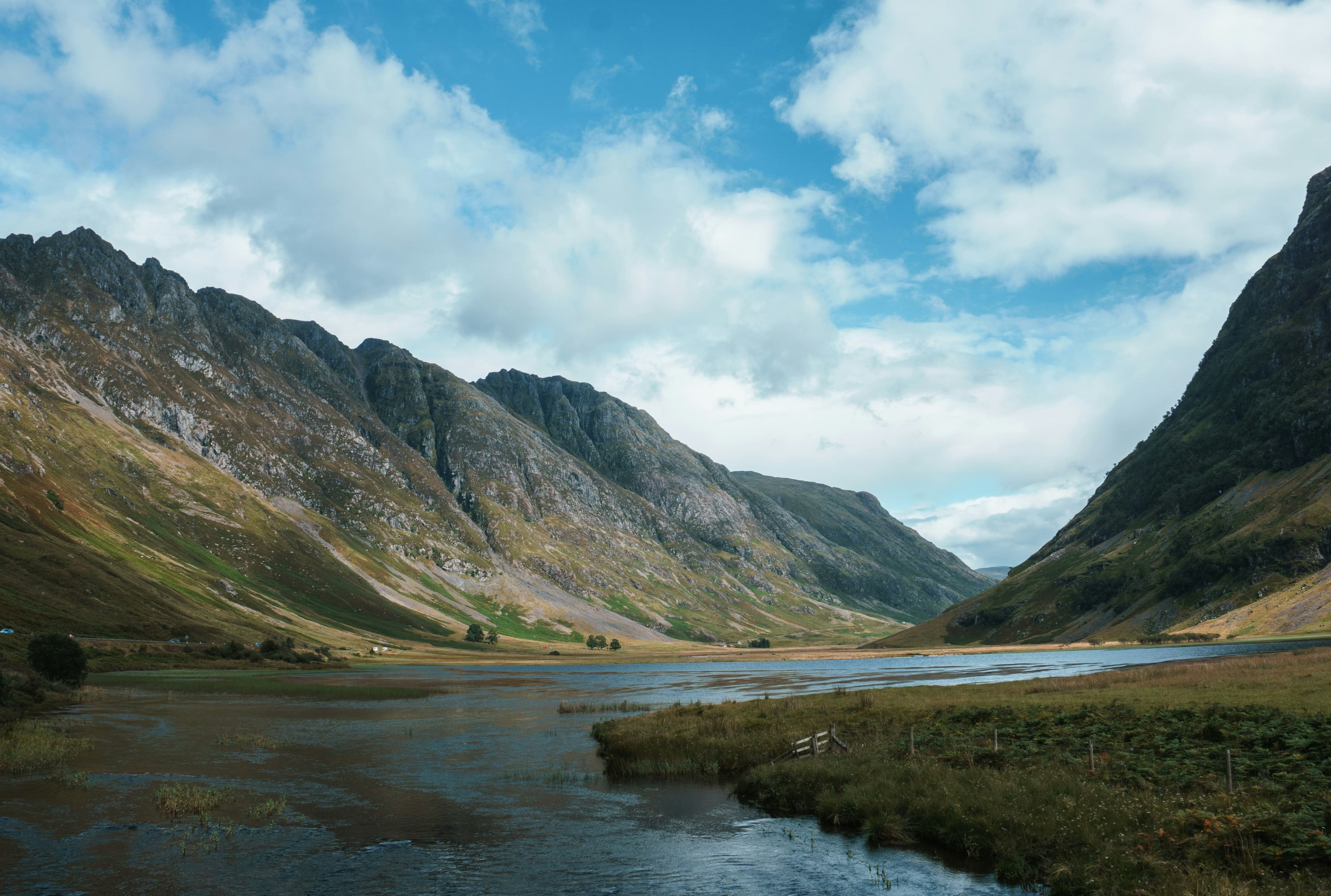
Cover photo: @Colin+Meg
The Aonach Eagach is the narrowest and most exposed ridge scramble on the British mainland. It is ten kilometres long. Once you reach the point of no return — and there is a point of no return — the only option is forward. This is what that means.
From the floor of Glen Coe, looking up, the Aonach Eagach appears as a ragged line of dark serrations against the Scottish sky. The name, in Scottish Gaelic, means the notched ridge. From below, it looks exactly like that — a jaw of broken teeth along the northern edge of the glen, the gaps between the pinnacles suggesting something that was whole once and has been steadily broken apart by weather and time. From below, it looks dramatic but manageable. Distance does that.
When you are standing on it, the scale changes entirely. The ridge is at places barely wide enough for two feet placed side by side. On each flank, steep grass gives way to scree, and scree gives way to cliffs that drop hundreds of metres to the valley floor. There is no path down that does not involve serious danger. The ridge runs east to west for ten kilometres linking two Munros — Meall Dearg at 953 metres and Sgòrr nam Fiannaidh at 967 metres — and somewhere in the middle, at a section known as the Crazy Pinnacles, the scramblers who thought they understood what they had signed up for discover that they did not.
From below, it looks dramatic but manageable. Distance does that. When you are standing on it, the scale changes entirely.
The Point of No Return Most mountain routes have exits. A trail that becomes too difficult can be reversed. A ridge that turns dangerous in deteriorating weather can be abandoned for a descent into the valley below. The Aonach Eagach is not like most mountain routes.
Once a scrambler has committed to the section between Am Bodach and Stob Coire Lèith — roughly the central third of the traverse — there are no safe descents on either side. The south face drops into Glen Coe in a series of cliffs and steep gullies that have killed experienced mountaineers attempting to escape the ridge in poor conditions. The north face is equally unforgiving. The Clàchaig Gully on the western end has claimed multiple lives. The only safe way off the Aonach Eagach, once past the point of commitment, is to complete the traverse.
This is not a warning that discourages. It is a fact that clarifies. The Aonach Eagach selects its participants with a precision that no permit system or entry requirement could replicate. The ridge itself decides who belongs there and when. An athlete who arrives underprepared, or who misjudges the weather, or who starts too late in the day, will find this out at a moment when the discovery can no longer be undone.
The ridge selects its participants with a precision no permit system could replicate. It decides who belongs there and when.
What Grade 2/3 Actually Means on the Aonach Eagach The Aonach Eagach is graded 2/3 as a scramble, with some guidebooks classifying sections as a Moderate rock climb. These grades are technically accurate. They are also, in isolation, misleading.
The technical difficulty of any individual move on the ridge is not, in most places, extreme. The holds are good. The rock — on a dry day — is solid. An experienced scrambler, moving carefully, will find nothing on the Aonach Eagach that is beyond their physical capability in isolation. The thing that makes it serious is not the grade of any single section. It is the sustained exposure. The ridge demands not a single moment of great technical difficulty but several hours of continuous concentration on terrain where a lapse of attention carries consequences that are not recoverable.
The Crazy Pinnacles section, halfway along the ridge, is the point that separates those who have done the Aonach Eagach from those who have started it. Here the ridge narrows to its minimum width. The pinnacles must be climbed and descended on their flanks, moving across steep rock with drops of hundreds of metres on both sides. There is a particular downclimb near the beginning of this section — a steep sloping slab that must be descended facing the rock, with no clear line of sight to the footholds below — that stops more parties than any other single feature on the route.
The ridge demands not a single moment of great difficulty but several hours of continuous concentration on terrain where a lapse of attention carries consequences that are not recoverable.
Connect with training partners, earn travel miles, and discover terrain worth crossing borders for.
Join ZealZagFollow us on InstagramThe Weather That Changes Everything Glen Coe sits in the western Scottish Highlands, where Atlantic weather systems arrive without warning and without restraint. The glen is one of the wettest places in Scotland. The mountains above it are exposed to wind speeds that make standing difficult and wet rock that removes every friction advantage a scrambler relies on. The Aonach Eagach in good conditions is a serious and committing route. The Aonach Eagach in deteriorating conditions is something else entirely.
Rain transforms the rock. The schist and quartzite of the ridge, solid and reliable when dry, become slick under moisture in a way that reduces the margin for error to near zero on the steeper sections. Wind, funnelled along the ridge by the valley below, can destabilise a scrambler on the narrowest sections with a force that is difficult to anticipate. In winter, the Aonach Eagach becomes a full Scottish mountaineering route, graded II/III on the ice climbing scale, requiring crampons, ice axe, and the technical knowledge to use them on mixed ground.
The standard advice — choose a dry day, check the forecast, start early, move with a purpose — is not caution for its own sake. It is the minimum operational requirement for a route where the weather is not background but protagonist.
The Ridge and the People Who Have Fallen The Aonach Eagach has a fatality record that is worth understanding before committing to the traverse. In 2009, two experienced hill walkers died in separate incidents after falling into the Clàchaig Gully. In 2014, an experienced hiker fell nearly 150 metres to her death on the ridge. In 2017, an experienced fell runner died in the Clàchaig Gully. In August 2023, two climbers and their mountain guide died while attempting the traverse.
These are not the deaths of reckless beginners. They are the deaths of experienced people in a place that does not grade its consequences. The ridge is indifferent to your record. It responds only to the present moment — to the condition of the rock under your boots right now, to the wind speed at this exact section, to the quality of your attention in this specific move. Experience is useful on the Aonach Eagach. It is not sufficient.
The ridge is indifferent to your record. It responds only to the present moment.
What the Aonach Eagach Gives Back None of this is argument against going. It is argument for going prepared, and for understanding what prepared means on this particular route.
Because what the Aonach Eagach offers, on a clear day with dry rock and a competent party moving well, is something that exists almost nowhere else in the British Isles. The views from the ridge crest extend across Glen Coe and its three famous buttresses, north to the Mamores and the dark pyramid of Ben Nevis, east along the full length of the glen to the Blackwater Reservoir, west to the sea lochs and the islands beyond. The air at 967 metres, when the weather holds, has a quality that is difficult to describe to anyone who has not stood in it. The movement on the rock — hands and feet working together on terrain that demands full physical engagement — produces a state of attention that clears everything else out of the mind with a completeness that training alone cannot achieve.
An athlete who completes the Aonach Eagach traverse in good conditions has spent a day using their body in the way it was designed to be used — not on a road or a track or a prepared surface, but on the actual mountain, reading terrain, managing exposure, making decisions with incomplete information under physical duress. That experience does not need to be inflated. It is exactly what it is.
The movement on rock — hands and feet working together on terrain that demands full engagement — produces a state of attention that clears everything else out of the mind.
The Guide Who Knows Where the Rock Goes Slick The Aonach Eagach is one of the routes in the British Isles where the case for a local guide is not just strong but obvious. Not because the terrain is beyond competent scramblers — it is not. But because the margin between a successful traverse and a fatal one is, on this ridge, substantially narrower than on most routes, and a local guide narrows it further in ways that experience from elsewhere cannot replicate.
They know which sections of rock hold moisture longest after rain and stay slick for hours after the sky has cleared. They know the specific downclimb sequence on the initial descent from Am Bodach that most parties get wrong the first time. They know the descent route from Sgòrr nam Fiannaidh that avoids the Clàchaig Gully without requiring navigation in failing light. They know how the ridge behaves in every season, in every type of weather, in every combination of conditions that Glencoe produces across a year. This knowledge is not in any guidebook. It accumulates through repetition on the actual terrain, in all conditions, over years.
ZealZag exists to put that person on the map. The local guide who has traversed the Aonach Eagach in October rain and July sun and February ice, who knows the ridge the way someone knows a route they have taken many times by instinct as much as memory. That athlete, visible on the ZealZag map in Glencoe, is the difference between a traverse and a safe traverse.
Getting to the Aonach Eagach Glencoe is located in the Scottish Highlands, approximately 90 minutes north of Glasgow and 30 minutes south of Fort William via the A82. The eastern trailhead is located off the A82 at the small parking area at grid reference NN173567. The traverse is completed east to west. Distance: approximately 10 kilometres. Elevation gain: approximately 1,200 metres total. Grade: 2/3 scramble, some sections graded Moderate rock climb. Time: 6 to 9 hours depending on conditions and party speed. No permit required. Helmets and harnesses optional but recommended for less experienced scramblers. Mountain guides available locally in Glencoe village. Do not attempt in wet conditions, strong wind, or without confirmed experience on exposed scrambling terrain.
Meet a ZealZag Athlete

Keep reading
Raglan In, J-Bay Out: Surfing's 2026 Championship Tour Heads to a New Left
The World Surf League has swapped the iconic right of Jeffreys Bay for the long lefts of Raglan, New Zealand, on the 2026 Championship Tour — a new proving ground, and a new destination for traveling surfers.
Race the Route: Riding the Col du Tourmalet Like the 2026 Tour
The 2026 Tour's first hors catégorie climb is a bucket-list ascent for any cyclist. Here's how to ride the Col du Tourmalet yourself — the numbers, the two approaches, and why you should do it with a local.
Tour de France 2026: The Tourmalet Awaits as Træen Defends Yellow Into the Pyrenees
A surprise leader in yellow, the favourites lying in wait, and the fabled Col du Tourmalet looming as the 2026 Tour's first hors catégorie test — the race for the mountains starts now.