Java in the Dry Season: Where the Island Tests You
By ZealZag Team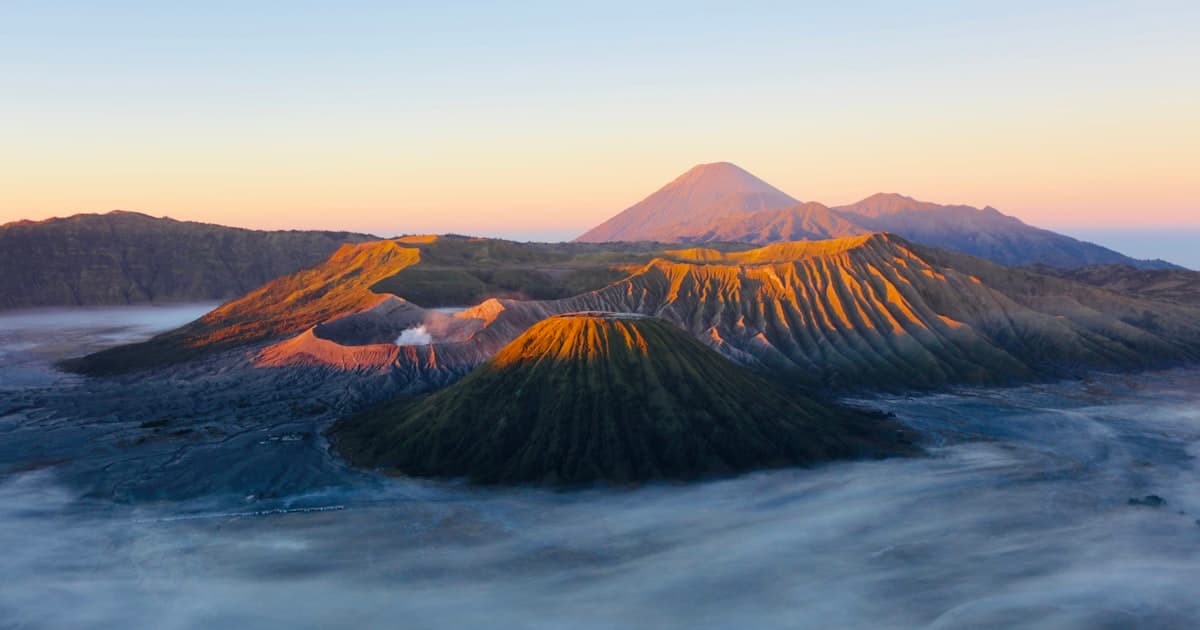
The first thing Java does is disorient you. Not in the way of jetlag or language — in the way of scale. You are standing in a country of 270 million people, on an island smaller than California, looking up at a chain of active volcanoes that runs its entire spine like vertebrae. The air smells of sulfur and clove smoke and, faintly, the sea. The roads are always moving. Something is always being carried somewhere. And yet above the noise — above the bajaj horns and the call to prayer and the roosters at four in the morning — there is the mountain.
From May onward, the dry season settles over Java like a held breath. The rains pull back. The clouds lift from the caldera rims. Trail conditions firm up, summit skies open, and the Indian Ocean organizes itself into clean, rideable swell along the southern coast. For athletes — hikers, runners, cyclists, surfers, climbers — this window is the reason to come. It does not last forever. By November the southwest monsoon returns, and Java closes its high places again.
The Volcano Circuit
Mount Semeru is where you understand what Java asks of you. At 3,676 meters, it is the highest point on the island, an active stratovolcano in Bromo Tengger Semeru National Park that erupts, quietly and continuously, from its summit crater. The standard approach begins at Ranu Pani village, a trail running and hiking route that climbs through alpine meadows and past crater lakes so cold and still they look painted. Most parties take two days. Strong trail runners attempt it in one, moving pre-dawn to catch the summit window before the daily eruption column shifts with afternoon thermals.
“The mountain doesn't care how fit you are. It cares whether you're paying attention.”
Forty kilometers to the north, Mount Bromo sits inside a vast sand caldera — the Tengger Caldera — surrounded by a lunar plain of volcanic ash. Bromo itself is only 2,329 meters, accessible enough that tourists arrive by jeep for sunrise. But athletes come differently: on foot across the Sea of Sand, running the crater rim, moving through the sulfur-stung air at a pace that makes the landscape feel earned. The Tengger Horseback Highlands above the caldera offer some of the best trail running terrain in Southeast Asia — hard-packed volcanic soil, open ridgelines, views that stretch to Semeru's plume on clear mornings.
Ijen, near the eastern tip of Java, is something else entirely. The trek to the crater rim is a 3-kilometer climb on a miner's trail — the same path men walk every night carrying loads of sulfur on their shoulders. The turquoise acid lake at the bottom, the blue flames that ignite in darkness when sulfuric gases combust, the miners moving through that light with baskets and chisels — it is one of the stranger places on earth to run or hike. Athletes who go there before dawn, moving quickly up the trail in the dark, find themselves sharing the mountain with the men who work it. That proximity is not comfortable. It is not supposed to be.
Riding Java's Backbone
Cyclists have been discovering central Java for years, and the roads between Yogyakarta and the Dieng Plateau remain among the most compelling on the island. The Dieng Plateau itself sits at 2,000 meters in the Kedu Plain highlands — a geothermal zone of hissing fumaroles, ancient Hindu temples, and farms growing potatoes in volcanic soil. The climb from Wonosobo is long and consistent, gaining over 1,200 meters on roads that wind through terraced farmland before opening onto the plateau's strange, misty flatness.
Road cyclists based in Yogyakarta can string together multi-day routes that link Dieng to Borobudur — the 9th-century Buddhist stupa that sits on its own hill in the plain below — then continue south toward the coast. The roads are not empty. Java is never empty. But the traffic has a rhythm to it, and cyclists who leave before six find stretches of morning road that belong entirely to them.
For mountain bikers, the slopes above Malang in East Java offer a rougher proposition — singletrack through tea plantations, descents across volcanic scree, trails that require both fitness and technical competence. Local guides are essential. The terrain shifts quickly, and the paths that appear on maps don't always appear on the ground.
Connect with training partners, earn travel miles, and discover terrain worth crossing borders for.
Join ZealZagFollow us on InstagramThe Southern Coast
Pangandaran sits on a narrow isthmus on West Java's southern coast, flanked by national park on one side and the Indian Ocean on the other. During the dry season, consistent southwest swell wraps into the points and reef breaks along this stretch. Batu Karas, forty minutes east, is the wave that serious surfers seek — a long left point that works best on larger swells, technical enough to reward skill without being punishing to intermediate surfers.
“The water here is warm and green and completely unimpressed with your credentials.”
Java's southern coast is not Bali. There are no beach clubs, no curated sunsets, no infrastructure built around the idea that you have arrived somewhere you are owed a good time. What there is instead: fishermen pulling nets at dawn, warungs that serve grilled fish and rice and nothing else, and waves that have been running their geometry across the reef long before anyone thought to name them.
The Limestone Question
East of Yogyakarta, the Gunung Kidul plateau holds some of the best sport climbing in Southeast Asia. The limestone caves and cliffs at Siung Beach, Kalisuci, and Jomblang offer routes from 5 to 8c — bolt-equipped lines on karst formations that drop directly to the sea or into cave systems so deep they require rope descents to reach the base. The climbing community here is small and serious. Routes are maintained by local clubs. New lines are still being established.
Yogyakarta itself functions as the athlete's base camp for central Java — a city of two million people with a functioning transit system, excellent food, proximity to Borobudur and Prambanan, and a culture of physical activity that produces cyclists, runners, and climbers at a remarkable rate. The streets at five in the morning are full of people moving. This is not performance. It is simply how the city begins.
What Java Does to Athletes
At some point — on the shoulder of Semeru, or moving through the Sea of Sand before light, or grinding up toward Dieng with your lungs doing arithmetic — Java stops being a destination and becomes a condition. The island metabolizes you. It asks questions that have nothing to do with fitness metrics or segment times. The sulfur miner carrying 80 kilograms of rock down a pitch-black trail while you hike up it with trekking poles and a hydration bladder is not a rebuke. He is information. About effort and economy and what a body can be asked to do when the asking is not optional.
Athletes who come to Java for performance often leave thinking about something else entirely. About what they were measuring and why. About the difference between difficulty chosen and difficulty assigned. The island does not resolve this. It simply makes the question unavoidable.
“You come here for the mountains and leave thinking about the miners. That's not a coincidence.”
Finding Your People Through ZealZag
The athletes who know Java best are the ones who live there — the trail runners from Malang who train on Semeru's lower slopes every weekend, the Yogyakarta climbing crew who bolted the first routes at Siung, the cyclists who have mapped every road between Dieng and Magelang by feel. Getting to these people used to require either luck or the right introduction.
ZealZag changes that geometry. The platform connects visiting athletes with locals who are doing the same sports in the same places — not as guides or service providers, but as athletes. A trail runner in Surabaya who runs Bromo twice a month can show you the lines that don't appear on any map. A climber from Yogyakarta knows which routes at Gunung Kidul are in condition after a dry week and which ones are still seeping. A surfer from Pangandaran can tell you when Batu Karas is working and when to drive east to find something better.
This is what the platform was built for: not tourism, but connection between people who move through places in the same language — the language of physical effort, of terrain read correctly, of knowing when to push and when to stop.
Getting to Java
Most international connections land at Soekarno-Hatta International Airport in Jakarta (CGK). From there, domestic flights reach Yogyakarta (JOG), Surabaya (SUB), and Malang (MLG) in under two hours. For East Java objectives — Semeru, Bromo, Ijen — Surabaya is the logical gateway; overnight trains from Surabaya to Malang or Probolinggo put you in position for mountain approaches without losing a day to ground transfers.
The dry season runs May through October, with June through September offering the most reliable summit weather. Permit systems exist for Semeru and Bromo — these fill during Indonesian school holidays in July and August, so book ahead. Gunung Kidul climbing requires no permit. The surf at Pangandaran runs year-round but peaks in dry season swell.
Budget for heat, for bureaucracy, for the unexpected day when the plan changes because the mountain says no. Java rewards athletes who arrive with an agenda and stay with an open hand.
---
Keep reading
Race the Route: Riding the Col du Tourmalet Like the 2026 Tour
The 2026 Tour's first hors catégorie climb is a bucket-list ascent for any cyclist. Here's how to ride the Col du Tourmalet yourself — the numbers, the two approaches, and why you should do it with a local.
Tour de France 2026: The Tourmalet Awaits as Træen Defends Yellow Into the Pyrenees
A surprise leader in yellow, the favourites lying in wait, and the fabled Col du Tourmalet looming as the 2026 Tour's first hors catégorie test — the race for the mountains starts now.
Race the Route: Stage 8 of the 2026 Tour — Périgueux to Bergerac Through the Dordogne
Today's Stage 8 is a flat 180.4 km run from Périgueux to Bergerac through the Dordogne. Here's how to ride the same terrain the peloton races — and turn it into your own endurance session.