From One Finish Line to Two: The Story Behind Ironman's Kona and Nice World Championships
By ZealZag TeamThe first Ironman Triathlon took place on February 18, 1978, on the island of Oahu, Hawaii. Fifteen people entered. Twelve finished. Gordon Haller, a Navy commander and taxi driver, crossed the line first in 11 hours and 46 minutes.
The race was the idea of John Collins, another Navy commander and endurance athlete, who had been part of a debate about which category of athlete was most fit: swimmers, cyclists, or runners. Collins resolved the debate by proposing a single event that combined three existing Oahu races — the Waikiki Roughwater Swim (2.4 miles), the Around-Oahu Bicycle Race (112 miles), and the Honolulu Marathon (26.2 miles). The combined distances became the Ironman standard. Collins's instruction to finishers: "Swim 2.4 miles, bike 112 miles, run 26.2 miles. Brag for the rest of your life."
The race stayed in Hawaii, but moved to the Big Island — to Kailua-Kona, on the drier Kohala Coast — for the 1981 edition, where the course remains today. The lava fields of the Queen Ka'ahumanu Highway, the crosswinds on the Natural Energy Lab section, the run along Ali'i Drive through the town centre: these became the defining images of long-course triathlon globally.
What Made Kona the Standard
The combination of heat, humidity, wind, and altitude-at-sea-level that Kona delivers is physiologically unlike most racing environments. Surface temperatures on the lava can exceed 50°C in the early afternoon. The trade winds that make the Queen K a scenic highway become a direct headwind on the return leg of the bike course. The marathon run through the Energy Lab — a facility built into the lava flats — demands heat management that training in temperate climates does not prepare athletes for.
This made Kona not just a championship venue but a specific athletic test. Qualifying for Kona and arriving fit was insufficient; arriving acclimatised, and having trained specifically for heat performance, was necessary for a competitive result. The course selection was not arbitrary — it filtered for athletes with specific adaptations, not just raw fitness.
ABC's Wide World of Sports first broadcast the race in 1982 — the year that Julie Moss, leading the women's race in the final metres, collapsed from dehydration and exhaustion and crawled toward the finish line, being passed by Kathleen McCartney who took the win. The footage made the Ironman World Championship internationally known overnight. The race was no longer an obscure Navy officer's experiment; it was a story about human limits in extremis, broadcast into American living rooms.
Qualification: The Architecture That Built the Sport
The current World Championship qualification structure distributes slots across the global Ironman race calendar. Athletes earn a Kona or Nice qualification slot by finishing in the top positions of their age group at designated Ironman-distance qualifying races. The number of slots allocated to each qualifying event depends on field size. A race with 2,000 participants might distribute 50 to 80 slots across age groups; a smaller regional qualifier might distribute 20.
The result is a qualification system that has driven the growth of Ironman-branded racing worldwide. Athletes who want to reach Kona or Nice need to race Ironman-branded events. The business model and the sporting aspiration are structurally aligned: every athlete in every qualifying race is also a potential World Championship aspirant.
A separate lottery allocation provides a path for athletes who cannot achieve competitive qualification times — a significant contributor to participation at both World Championship events.
Connect with training partners, earn travel miles, and discover terrain worth crossing borders for.
Join ZealZagFollow us on InstagramWhy Nice
From 2023, the Ironman World Championship split into two events: one in Nice, France (June), and one in Kona, Hawaii (October). Professional athletes race one gender group at each venue, with the assignment alternating annually. Age group athletes are allocated slots to both events.
Nice was not chosen arbitrarily. The Côte d'Azur has a reliable June climate: sea temperature in the Baie des Anges typically reaches 22 to 24°C, warm enough for comfortable open-water swimming without wetsuits but not hazardous. The bike course — heading west from Nice through the Maritime Alps foothills, climbing toward Puget-Théniers and beyond before returning — is substantially more demanding than Kona's lava field loop in terms of elevation gain. A typical Nice professional bike split involves two to three times the climbing of Kona. This shifts the performance requirements: where Kona rewards heat-adapted athletes with strong running, Nice disproportionately rewards climbers and riders with strong sustained power-to-weight ratios.
The Promenade des Anglais run — one of the most recognisable seafront roads in the world — provides a finish setting with immediate visual recognition beyond the triathlon community, a consideration for broadcast partners and global media reach.
What the Split Actually Changes
For professional triathletes, the split created two separate championship peaks within a single season. Nice in June and Kona in October are approximately four months apart — enough recovery time to compete at both, but insufficient time to peak twice with standard periodisation approaches. Professionals who target both championships must decide whether to compress two build-and-peak cycles into a single season or to weight one event over the other. The practical result has been that most top professionals choose a primary event each year, competing at the secondary one in whatever form their season calendar permits.
For age groupers, the split effectively doubled the supply of World Championship slots relative to the single-venue format. More qualifying slots are available in total, distributed across both Nice and Kona allocations. Athletes who qualify for Nice are not also automatically in Kona — the two events have separate qualification pools. Athletes who can travel to both and qualify for both can race both.
The emotional weight of the two venues remains unequal. Kona carries forty-four years of accumulated meaning: the broadcast images, the Ali'i Drive finish, the lava fields in afternoon heat. Nice carries a harder course and a European identity. First-time World Championship aspirants tend to orient toward Kona because that is the version of the race that made them triathletes. Athletes who have done Kona multiple times and want a different kind of test increasingly treat Nice as the progression.
Getting to Either
Kona qualification typically requires age-group finishing positions in the top five to ten percent of a competitive field at a qualifying Ironman event, depending on age group depth. In popular age groups (35-39, 40-44 male), a qualifying slot can require a sub-nine-hour performance at a fast course. In smaller or older age groups, qualifying times are slower.
Nice qualification follows the same structure. Slots are distributed separately from Kona allocations; qualifying for Nice does not secure Kona entry and vice versa. Some athletes pursue both qualifications in the same season, targeting qualifying races that offer slots to each venue.
Both events require significant advance planning for international travel: accommodation in Kailua-Kona is booked out eighteen months ahead by returning qualifiers, and Nice race week coincides with peak early-summer tourism on the Riviera. Neither venue is a casual last-minute arrival — the logistics begin at the moment the qualifying slot is accepted.
Keep reading
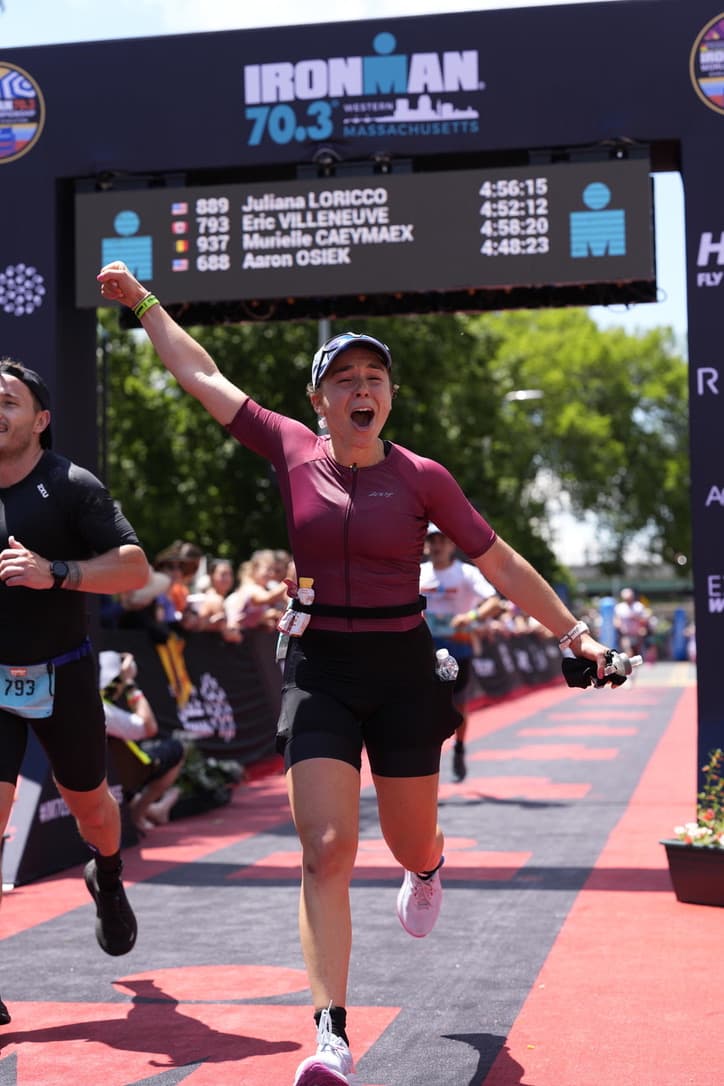
Running in Purple
A Law Student’s Journey Beyond the Finish Line.
The Bec des Rosses and the Thirty-Year Competition That Changed Freeride Skiing
In 1996, a small group of skiers dropped off the Bec des Rosses — a 55-degree face above Verbier — in what became the first edition of the Verbier Xtreme. Three decades later, that same face is the closing venue of a global competitive series. The route from sidecountry dare to world championship is not a straight line.
Nazaré: How a Portuguese Fishing Town Became the Capital of Big-Wave Surfing
Nazaré existed before 2011 as a beach town with a funicular and a seafood economy. Then Garrett McNamara rode a wave measured at 78 feet, a photograph went viral, and a submarine canyon became the most consequential piece of seabed in big-wave surfing.