The Trail That Cannot Be Reached Any Other Way
Eleven miles of coastline no road has ever touched. The Kalalau Trail on Kauai's Na Pali Coast is earned on foot or not at all.
By ZealZag Team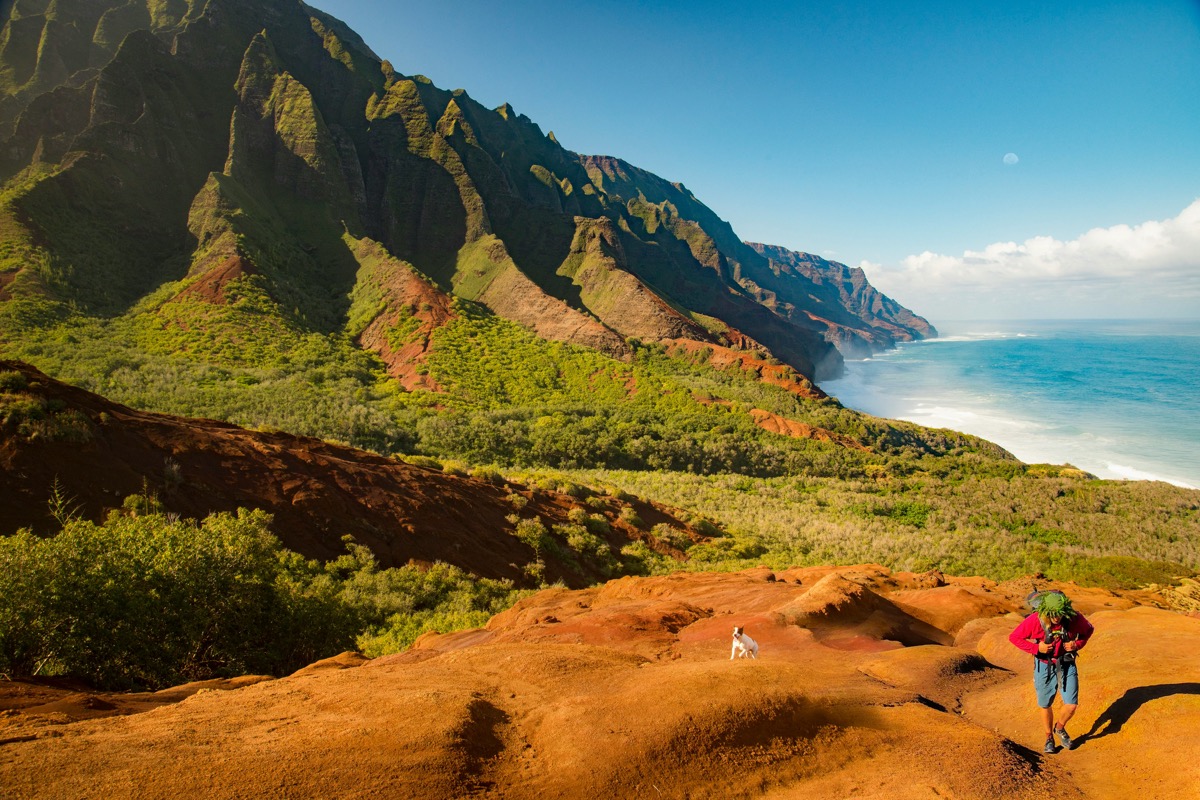
::credit[Photo by Alain Bonnardeaux]
The trail begins at Ke'e Beach and immediately starts to climb. Within the first hundred metres, the road behind you disappears. The sound of cars disappears. The twenty-first century disappears. What remains is a narrow path cut into the side of a mountain that drops straight into the Pacific Ocean, a wall of green so dense it blocks the sky, and somewhere ahead, eleven miles of coastline that no vehicle has ever crossed and no road has ever reached.
This is the Kalalau Trail on the Na Pali Coast of Kauai. It is not the longest trail in Hawaii. It is not the highest. But it is almost certainly the most consequential, because once you step past the first ridgeline, the only way forward is the trail, and the only way back is the trail, and the landscape between those two points is so remote, so physically demanding, and so staggeringly beautiful that hikers who complete it often describe it as the most significant experience of their athletic lives.
"Na Pali in Hawaiian means the cliffs. It is a description, not a name. And it does not begin to capture what is actually there."
Why Has No Road Ever Reached the Na Pali Coast?
Kauai is a small island, 25 miles long, 33 miles wide. A single highway circles most of it. But on the northwest shore, the mountains rise so steeply from the ocean that the road simply ends. There is no way around. There is no way through. The Na Pali Coast has been inaccessible by vehicle since Hawaii was formed by volcanic activity millions of years ago, and it remains inaccessible today.
This means that the coastline, sixteen miles of dramatic sea cliffs, hidden valleys, cascading waterfalls, and beaches accessible only by sea or on foot, has been protected from development not by legislation or conservation effort, but by geology itself. The cliffs are too sheer. The terrain is too vertical. The ocean is too powerful. Nature built a wall that engineers have never been able to breach.
The Kalalau Trail is the only land route through it. Originally built in the late 1800s to connect the Hawaiian settlements that once existed in the valleys along the coast, it has been hiked by adventurers, backpackers, and athletes ever since. The ancient Hawaiians who lived in these valleys grew taro on terraced fields whose stone walls can still be seen today, tucked into the jungle alongside the trail. They lived in one of the most remote places on earth and called it home.
"The only way in is on foot. The only way out is the same. Everything in between is earned."
What Does the Kalalau Trail Look Like?
The Kalalau Trail runs eleven miles in a single direction from Ke'e Beach at Ha'ena State Park on the north shore to Kalalau Beach at the end of the navigable coast, where the cliffs become too sheer to traverse even on foot. It does not loop. It does not branch. It goes one way and the hiker either completes it or turns back.
The trail crosses five valleys: Hanakapi'ai, Ho'olulu, Waiahuakua, Hanakoa, and Kalalau. Each has its own character. The first two miles to Hanakapi'ai Beach are the most accessible, a popular day hike that gives visitors a taste of the coast without requiring the commitment of the full trail. The beach at Hanakapi'ai is dramatic and beautiful. The ocean is almost always too dangerous to enter. The surf here kills people every year.
Beyond Hanakapi'ai, the trail becomes a different thing entirely. The terrain climbs 800 feet out of the valley on steep switchbacks before traversing the Hono o Na Pali Natural Area Reserve, a protected expanse of native lowland forest where the trail passes through hanging valleys and along ridgelines with severe dropoffs on the ocean side. This is where the Na Pali Coast reveals itself in full.
The sea cliffs here plunge hundreds of metres straight into the water. The emerald peaks rise behind. The Pacific stretches to the horizon without interruption.
What Is Crawler's Ledge?
The most notorious section comes later: Crawler's Ledge, a narrow cliffside path where the trail is barely wide enough for a single hiker and the ocean waits hundreds of feet below. It requires concentration, steady nerves, and absolute focus. Hikers who have done it describe the experience not with fear but with a particular kind of clarity, the mind emptied of everything except the next step.
"At Crawler's Ledge, the mind empties of everything except the next step. That is the trail doing what only the trail can do."
How Do You Get a Permit for the Kalalau Trail?
The Na Pali Coast is heavily protected and strictly regulated. The trail does not belong to whoever shows up. It belongs to whoever planned ahead.
To enter Ha'ena State Park at the trailhead, all non-Hawaii residents must make advance reservations at gohaena.com. The park has a 900-visitor-per-day limit. To hike beyond Hanakapi'ai Valley, which means entering the true wilderness of the Na Pali Coast, a camping permit is required regardless of whether the hiker plans to camp. Permits are available up to 90 days in advance through explore.ehawaii.gov and sell out quickly, particularly in summer. Only 60 people are permitted on the Kalalau Beach trail at any time.
This is not a place for spontaneous visitors. The Na Pali Coast rewards preparation and patience. The permit is, in many ways, the first test, a measure of how much the hiker actually wants to be there. Those who arrive without one turn back at Hanakapi'ai Beach. Those who planned months in advance walk on into the wilderness.
Maximum stay is five nights. No two consecutive nights at Hanakapi'ai or Hanakoa. Camping areas have no drinking water and no tables. Composting toilets are available at the main sites. The trail is as close to wilderness as it is possible to get in the United States, and the permit system exists to keep it that way.
What Awaits at Kalalau Beach?
At the end of the eleven miles, the trail descends through drier, more open terrain into Kalalau Valley, a vast amphitheatre of fluted cliffs that rise 1,200 metres above a white sand beach where the stream meets the ocean. In summer, sea caves just beyond the waterfall provide shelter. In winter, the surf reclaims the beach and fills the caves. The valley is ancient and indifferent to the people who pass through it.
Kalalau Beach is one of the most remote beaches in the United States. There is no road to it. There is no helicopter pad. There is no resort or hotel or cafe. There is the trail, the valley, the stream, the cliffs, and the ocean. Nothing else. Everything that arrives here, every hiker, every piece of equipment, every gram of food, was carried in on someone's back.
"Everything that arrives at Kalalau Beach was carried there on someone's back. That is the only way anything gets there. That is the only way it should be."
The movies know this. Jurassic Park was filmed here. Pirates of the Caribbean was filmed here. The Na Pali Coast has stood in for lost worlds and mythical islands because it looks like nowhere else on earth, because it is, in a very real sense, a place that the modern world has not yet reached. The geology made sure of that.
Who Should Guide You on the Na Pali Coast?
The Kalalau Trail takes experienced hikers approximately thirteen hours to complete one way. It crosses rivers that can flash flood without warning. It traverses sections where a fall would be fatal. It passes through terrain where the weather can change from clear skies to dangerous conditions within an hour. It is not a trail to be hiked alone by someone who does not know it.
The hikers who know Na Pali best are the ones who have walked it many times, in many conditions, across different seasons. They know where the river crossings are most treacherous after rain. They know which sections of trail deteriorate first when wet. They know the rhythm of the weather on the north shore, the way the light moves through the valleys in the early morning, the particular silence of Kalalau at dusk when the last day hikers have turned back and the valley belongs only to those who stayed.
This knowledge cannot be downloaded. It cannot be found on a trail app or a travel blog. It lives in the body of the athlete who has earned it through repeated effort, in all conditions, over years.
That athlete is exactly who ZealZag was built for. And for the visiting hiker who wants to experience Na Pali the way it was meant to be experienced, guided by someone who belongs to this coast, ZealZag is how you find them.
How Do You Access the Na Pali Coast?
Trailhead: Ke'e Beach, Ha'ena State Park, north shore of Kauai. Book up to 90 days in advance. Permits sell out quickly in summer. Maximum stay five nights. No fresh water available on trail, treat stream water. The first two miles to Hanakapi'ai Beach require no camping permit and are open to day hikers with park entry reservations.
::link[GoHaena.com|Park entry reservations for Ha'ena State Park](https://gohaena.com)
::link[explore.ehawaii.gov|Camping permits for Kalalau Trail (required beyond Hanakapi'ai)](https://explore.ehawaii.gov)